|
The following article was written
for the Orchid Species Bulletin published by the Orchid
Species Society, which is based in Brisbane,
Queensland in August 2009.
Bear in mind that any cultivation notes refer to the sub-tropical conditions of Southern Queensland, Australia.
Restrepiella ophiocephala
(Lindl.) Garay & Dunsterv.
was first described by John
Lindley as Pleurothallis ophiocephala
in the Botanical Register in 1838.
Lindley's description was based on plants collected from Mexico
and sent to him from Messrs Loddiges of Hackney and Mr
Barker of
Birmingham. The specific epithet was derived from the Greek ofis
(snake) and cephalos (head) in
reference to the flowers which resemble the open jaws of a snake's head.
Leslie Garay and G. C. K. Dunsterville
transferred this species to Restrepiella
in Venezuelan Orchids Illustrated in
1966. They placed 7 species within this genus, however nowadays the genus is
recognised as being monotypic with Rpa.
ophiocephala as the sole species. The other species now belong to Restrepiopsis
which is more closely allied to Octomeria
and Pleurothallopsis. Restrepiella differs from the related genera Restrepia in lacking hair-like attachments on the lip and in having
a mobile lip, and from Pleurothallis
in having 4 pollinia rather than two pollen-masses.
Rpa.
ophiocephala is a medium sized robust epiphyte
with clustered erect stems that are 8-23 cm long. The stout stems have a tubular
bract sheathing the middle and bear a stalked oblong-lanceolate, leathery leaf
that is 8-18 cm long and 1.2-4.3 cm wide. Up to 4 clustered inflorescences are
produced successively from the base of the leaf. Each inflorescence bears one
flower that is subtended by large papery bracts. Downy or softly haired on the
outer surface, the flowers are variable in colour and are 1.4-2 cm long.
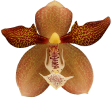
The flowers of Rpa. ophiocephala may vary from rarely pure yellow to pale
yellowish-brown and are variably spotted with dull purple to nearly solid
maroon-purple. The elliptic dorsal sepal is fused at the base to the lateral
sepals and the lateral sepals are joined almost to the apex. Its small elliptic
petals are ciliate along the margin. In some forms the flowers do not open very
widely while others are almost flat. The flowers are strongly and unpleasantly
scented and last for about 4 days. Blooms may be produced sporadically over a
period of several months.
Rpa.
ophiocephala is distributed from Mexico, Belize,
Guatemala, El Salvador
and Costa Rica
where it is found in riverine forest at low altitudes
between 70-200 m. A warm-growing species, Rpa.
ophiocephala appears to be one of the easy-to-grow and flower pleurothallids
for subtropical regions. Plants require around 70% shade, high humidity with
good air circulation. Grow it in a small pot in a well-drained medium and keep
the roots evenly moist all year round. Suitable potting media include fine to
medium bark, sphagnum moss or a combination of perlite with peat moss. Plants
grown in small pots may tend to be top-heavy so terracotta pots can be an
advantage.
|