|
The following article was written
for the Orchid Species Bulletin published by the Orchid Species Society, which is based in Brisbane,
Queensland in
October 1997.
It is apparently a frequently encountered and variable species with a wide distribution from Mexico, throughout Central America to the Western Cordillera of Colombia. Rstp. muscifera
is variable in plant size with erect ramicauls (pleurothallid stems) that are 2.5-17 cm long,
which are
enclosed by 4-10 thin, whitish sheaths. The erect, elliptic-ovate, thick
leathery leaf is 3.5-8 cm long and 1.5-3.5 cm wide and is often suffused with purple
on the underside. Solitary flowers are produced successively in spring. They are
borne in a bunch at the
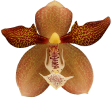
base of the back of the leaf on a slender 7-20 mm long peduncle. The erect dorsal sepal of Rstp. muscifera is narrowly triangular with a thickened club-shaped tip and is white, yellow or rose, more or less spotted with purple. Its lateral sepals are joined to near the apex and is also white, yellow or rose, variously suffused, dotted, spotted and blotched with red-purple. The narrow petals also have thickened club-shaped apices and are white to yellow or rose, often with a purple spot at the base. The oblong-ovoid lip is again of the same variable combination of colours and markings. Being such a variable and widespread species it is no wonder that Rstp. muscifera has quite a number of synonyms as no two populations are similar in size, shape and colour. Carlyle Luer (1996) says that broad-leaved forms appear distinctly different from narrow-leaved forms, but the same variations of the flowers occur in both forms. Rstp. muscifera is distinguished from other species of the genus by the thick leathery ovate, more or less acute leaves. Also the short peduncles bear the flower close to the base of the leaf on the underside. In addition the dorsal sepal and petals are distinctly club-shaped with the petals basically decurved.
|