|
The following article was written for the
Orchid Species Bulletin published by the Orchid Species Society,
which is based in Brisbane, Queensland in October 2002.
Bear in mind that any cultivation notes refer to the sub-tropical conditions of Southern Queensland, Australia.
Phragmipedium
lindleyanum (Schomb.
ex Lindl.) Rolfe was first collected by
Richard Schomburgk in 1838. Schomburgk
named it in honour of John Lindley, who described it as Cypripedium lindleyanum in Genera
and Species of Orchidaceous Plants in 1840.
Lindley's description was based upon a dried herbarium specimen that
Schomburgk had collected near Mt. Roraima,
Guyana. Robert Rolfe
transferred it to Phragmipedium in the
Orchid Review in 1896.
A terrestrial plant, Phrag. lindleyanum has short clustered stems with about 5
linear-lanceolate rigid leaves that are up to 50 cm long and 6 cm broad.
Tall inflorescences that are up to 1 m tall are produced from the centre
of the mature growths. The
inflorescence is a simple upright raceme or it may be a shortly few-branched
panicle that is green with reddish brown hairs.
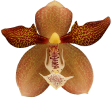
The 2-30 flowers are borne at the apices, opening one at a time and are
up to 8.5 cm across. They have green
or yellow-green sepals and petals. The
petals have purple veins, margins and apices and the pouch-like, ochre-yellow
lip is veined purple with light purple spots on the side-lobes.
Its staminode is yellowish.
Lucile McCook (1998) treats Phrag.
sargentianum (Rolfe) Rolfe from Brazil
as a synonym for Phrag.
lindleyanum. When Robert Rolfe
first described Phrag. sargentianum he
distinguished it from Phrag. lindleyanum
by the chevron-shaped white spots on the lip.
These spots are not easily found on dried herbarium specimens such as the
one that John Lindley used as the type for Phrag.
lindleyanum. McCook says that Phrag. lindleyanum is a variable species that may have a yellowish
leaf margin and flowers that vary in
colour intensity and hairiness. Studies
by Frank Stermitz et al. (1981) showed that Phrag.
lindleyanum and Phrag. sargentianum
have significantly different alkaloids, which may be grounds for keeping the two
as separate taxa. Phrag.
lindleyanum is found in Guyana
and neighbouring
Venezuela, and also in
Pernambucco, Brazil.
In
Guyana, Phrag. lindleyanum
grows on rocky cliffs at around 3,000 m altitude.
In this habitat the plants receive full morning sun and about 60% shade
for the remainder of the day. Good
air circulation and frequent cool breezes keep the plants cool.
Constant seepage down the granite substrate supplies regular moisture,
together with dense mists in the late evening and early morning.
The humus amongst which the roots grow and the constant water supply are
both quite acidic. Temperatures
range from 18 oC at night to 26 oC during the day.
Phrag.
lindleyanum seems to be easy to grow in the
south-east
Queensland
region. Plants
require bright light such as 60-70% shade and good air circulation at all times.
Any well-drained potting medium is suitable and the roots should never be
allowed to dry out. A shallow tray
beneath the pot may help keep an adequate supply of moisture to the roots.
Addition of dolomite or lime to the medium is best avoided so that the
roots are kept in an acidic environment.
|