|
The following article was written for the
Orchid Species Bulletin published by the Orchid Species Society,
which is based in Brisbane, Queensland in December 2006.
Bear in mind that any cultivation notes refer to the sub-tropical conditions of Southern Queensland, Australia.
Paphiopedilum
delenatii
Guillaumin
was described by André Guillaumin in Bulletin
de la Société Botanique de France in 1924, based upon plants collected in
northern
Vietnam
(Tonkin). He named the
species for M. Delenat of Paris, who was the first to flower it in European cultivation.
Up until recently all of the plants in cultivation have been the result
of the selfing of the original plant in the collection of the French Nursery of
Vacherot & Lecoufle. Around 1990
or 1991 Paph. delenatii was rediscovered near Nha Trang, Vietnam. Despite CITES,
large numbers of plants were exported to Taiwan, Japan,
Europe
and the U.S.A.
Paph.
delenatii is a terrestrial plant that is rather
attractive even when not in flower. It
has clustered growths that consist of 6-7 two-ranked alternating, elliptic to
elliptic-oblong leaves that are up to 11 cm long and 3-4 cm broad.
The leathery leaves are mottled dark and pale green on the upper surface,
with the underside heavily spotted with purple.
Erect inflorescences emerge from the centre of the matured growths, which
are up to 22 cm long. The
inflorescence carries one, sometimes two or rarely three flowers at the apex.
The peduncle is purple and is covered with white hairs.
The
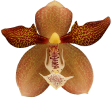
attractive flowers are 7.5-8 cm across and are lightly scented like sweet peas.
The sepals and petals are white, pink or pale pink, with the sepals often
darker on the outer surface. Its
pouch-shaped lip is often darker but can vary from white, pale pink or very dark
rose. The staminode of Paph.
delenatii is white with red and yellow markings.
Guido Braem described the pure white form as fma. albinum in The Genus
Paphiopedilum Natural History and Cultivation in 1998.
This form lacks any red-purple pigmentation in the leaves, inflorescence
and flower.
Endemic to southern Vietnam, Paph. delenatii
is found between 800-1,300 (-1,500) m altitude.
Plants grow on acidic soils on granite mountains.
It grows in shade in mossy crevices on vertical cliffs usually under open
evergreen broad-leaved forest, often near rivers and streams.
In its natural habitat, Paph. delenatii is subject to two distinct seasons.
A wet autumn is followed by a drier, occasionally very dry summer.
Rainfall is
relatively low from winter through to early summer.
Despite the low rainfall the average humidity is high so that plants
receive plenty of moisture from morning dew and condensation.
In winter temperatures range from 13-22 oC while during summer
the thermometer varies between 17-28 oC.
In keeping with its natural
habitat, Paph. delenatii requires a
well-drained potting medium. Plants
are intolerant of soggy mix, resulting in quick root loss.
Shading of 70% and good air circulation is important at all times.
During the warmer months plants should not be allowed to dry out for long
periods. Regular watering should be
given and the potting medium allowed to become nearly dry before the next
watering. In winter the watering
frequency can be reduced further, with water applied in the morning to prevent
the plant becoming too dry. Some
growers report that a distinct rest with long hours of sunshine are needed for Paph.
delenatii to flower.
|