|
The following article was written
for the Orchid Species Bulletin published by the Orchid
Species Society, which is based in Brisbane, Queensland in December 1997.
This name was overlooked until Leslie Garay resurrected it in 1974 in the Botanical Museum Leaflets of Harvard University. It is often grown under the synonym of Vandopsis parishii (Rchb.f.) Schltr., however in Vandopsis the lip is firmly, unmovably attached. Other distinguishing features separating the two genera are the distinct arcuate column and distinctively shaped pollinia found in Hygrochilus.
It is a large epiphyte with a short
stem that is up to 20 cm long, bearing elliptic-oblong leaves that are 11-23 cm
long and 2.5-7.5 cm wide in two ranks. Inflorescences that are longer than the
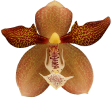
leaves bear 1-6 fleshy flowers that are 3.5-5 cm across. The typical flowers of Hy. parishii
have yellow to yellow-green sepals and petals that are whitish towards the base,
and are Perhaps more common in cultivation is the var. marriottianus (Rchb.f.) Pradhan, which is the same as the typical form except that it has solid reddish-brown to purple sepals and petals that are whitish towards the base. This variety was first published by Heinrich Gustav Reichenbach in the Gardeners' Chronicle in 1880 as Vanda parishii var. marriottiana. Udai Pradhan transferred it to Hygrochilus in the Indian Orchid Journal in 1987.
|