|
The following article was written for the
Orchid Species Bulletin published by the Orchid Species Society,
which is based in Brisbane, Queensland in December 2006.
Bear in mind that any cultivation notes refer to the sub-tropical conditions of Southern Queensland, Australia.
Encyclia
belizensis
(Rchb.f.)
Schltr. has
a much confused history, particularly as different authorities have interpreted
the type differently!
According to Robert Dressler and Glenn Pollard (1976),
Heinrich Gustav Reichenbach first described this species as Epidendrum
belizense in Linnaea. Ein Journal für
de Botanik in Ihram Ganzen Umfange in 1876.
The specific epithet comes from
Belize
and the Latin suffix –ense
(place, origin) for where the type specimen was collected.
Rudolf Schlechter transferred this taxon to Encyclia
in Beihefte zum Botanischen Centralblatt in 1918.
Dressler and Pollard at one stage reduced this species to Enc.
alata subsp. virella in Phytologia in 1971. The
authors, however, did not stay with that reduction in 1976.
Unfortunately
the confusion arises because Carl Withner (1998) points out that Enc.
belizensis should be known by the earlier name Enc. guatemalensis (Klotzsch)
Dressler & G.E.Pollard. Withner
cites the tracings by Leslie Garay of the flowers of the type for both Enc.
guatemalensis and Enc. belizensis
as being the same. In addition,
Withner believes that the species that Dressler and Pollard recognise as Enc. guatemalensis, which bears panicles of small glossy, mostly
maroon to dark reddish brown flowers that have a white lip streaked with
red-brown or purple, should be called Enc.
dickinsoniana (Withner) Hamer.
I now follow recent authors such as Joyce Stewart and
Mark Griffiths (1995), Ian McLeish et al. (1995) and Eric Hagsater et al. (2005)
who keep Enc. belizensis and Enc.
guatemalensis as separate taxa.
Enc. belizensis
has clustered conic-ovoid shiny pseudobulbs that are 3-4.5 cm long and 1.2-2 cm
broad. At the apex of each pseudobulb are two (sometimes three) narrowly
elliptic-lanceolate to nearly linear leaves that are 9-50 cm long and 1-2 cm
broad. Its pseudobulbs vary from
green to purple-brown and
the leaves may be dark green or purplish. Simple
racemose inflorescences, which may be sometimes few-branched, are produced from
the apex of the pseudobulbs from late spring to summer.
They are commonly erect and are 40-90 cm long bearing few to many
flowers. The flowers are usually
scentless but some cultivars may be fragrant.
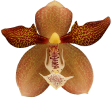
The flowers of Enc. belizensis are 3-4 cm across and are variable in colour.
Yellow-green to olive green, the sepals and petals are often variably
streaked with brown particularly towards the tips.
Its lip is cream to pale yellow with the bases of the side-lobes and
centre of the mid-lobe streaked with red-brown to purple along the veins that
are raised and minutely warty. The
winged column is greenish white, usually streaked with purple.
The flowers last for up to 5 weeks in bloom.
Recognition of Enc. belizensis is by the green or greenish flowers, the winged
column and the minutely warty lip. In
addition, the oblong lip side-lobes are about the same width from the base to
the apex. They are veined only at
the base and have clear white tips, which reflex back on each side of the column
apex.
Enc. belizensis
is distributed from
Belize,
Guatemala,
Honduras
and
Mexico, with an unconfirmed report from
Nicaragua. It is found
growing in open rocky outcrops, on the ground or on trees or shrubs usually in
dry, scrubby oak or semi-deciduous forest Grow Enc.
belizensis in a well drained medium and provide it with regular water during
the warmer months when it is actively growing.
Provide it with bright light such as 60-70% shade and a drier winter rest
period. During the rest period, the
roots like to dry briefly between waterings.
I would suggest a winter minimum of 12 oC with the plant kept
dry at night during the cooler months.
|